
Industrial Office Interior Design Trends & Ideas for 2026
In today’s fast-changing world, industrial office interior design is right at the top of the list for modern workplaces. Businesses now understand that to stay competitive, they need office spaces that feel strong and practical, yet also stylish and inspiring. By 2026, the goal is simple: get a balance between classic industrial elements and some modern design that improves how people work.
Data-driven research into Environmental Psychology shows that industrial spatial layouts directly influence Cognitive Load and employee retention. By 2026, the ‘Office as a Destination’ model focuses on high-performance environments.
Industrial-style offices are proving especially effective because they take the strength of old architecture and pair it with the benefits of open, flexible space. So teams can brainstorm together in open collaborative spaces while still having quieter areas to slip away to when they need to focus. When you combine that raw industrial look with up-to-date tech and smart layouts, the result is an office that’s visually impressive and helps people get the job done more efficiently.
Popular Industrial Office Design Styles Used in 2026
Industrial office interior design in 2026 is no longer just one look. Companies are experimenting with various industrial styles to align with their brand identity, workspace needs, and employee comfort. Whether the goal is to create a creative studio environment, a technology-focused workplace, or a sustainable office, industrial design can adapt while still preserving that raw, authentic character.
Loft Living for the Modern Office
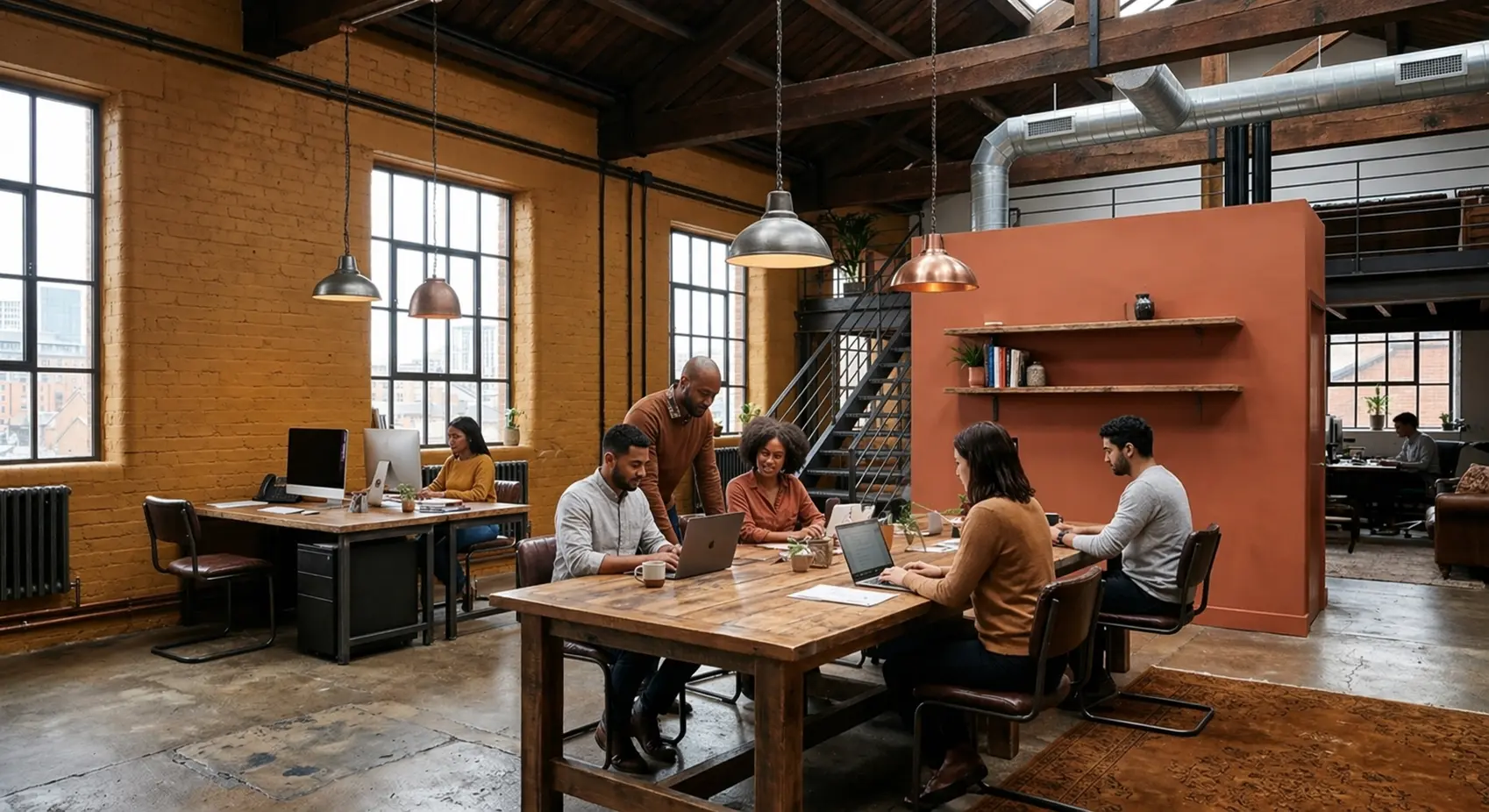
Urban loft style’s a big deal in 2026, and it’s easy to see why. Just think of a converted warehouse or a city loft – high ceilings, exposed brick, big metal-framed windows. It’s a space that’s guaranteed to get your creativity flowing naturally, no question. So it’s no surprise that start-ups, design studios, and creative agencies are all over this look.
Take a marketing agency, for example, set up in an open-plan office where everyone shares a desk, and big windows let in plenty of natural light—that kind of setup’s perfect for creating an energetic atmosphere.
Modern Minimalist Industrial
This style combines raw industrial materials with a highly organised and minimal layout. You see lots of neutral colours, simple furniture, and neat workstations – but they’re all still made with those raw, industrial materials. The result is a space that feels calm, organised, and still very on-brand for an industrial office.
A tech company might take concrete walls and metal fixtures, but pair them with sleek white desks and some minimal decor to create a modern office that’s clean and clutter-free yet still highly functional
Vintage Factory Style
The vintage factory style draws inspiration from old manufacturing buildings and adds a bit of nostalgic charm to the office. Think huge wooden desks, steel structures, antique lighting – and all sorts of reclaimed materials. It’s all about evoking the history of industrial spaces and giving your office a bit of that old-world charm.
Tech-Industrial Workspace
It integrates raw industrial aesthetics with IoT-enabled smart building systems and Ubiquitous Computing to support seamless hybrid work transitions. So you get smart lighting systems, modular desks, and integrated tech – all of which add up to support modern hybrid work models.
Eco-Industrial Design
Sustainability is fast becoming super important in office design & industrial spaces are starting to adapt. Eco-industrial offices combine raw industrial materials with all the best eco-friendly features – like recycled materials, indoor plants, natural lighting, and energy-efficient systems.
Why Choose Industrial Office Interior Design for Your Workspace?
Choosing industrial office interior design isn’t just about looking good; it also offers some practical advantages. Businesses that invest in corporate interior design often choose industrial office interiors because they offer functionality, openness, and a strong visual identity that really works for employees and long-term business growth.
• Better Space and Airflow
You know how some offices are a bit dull and cramped? Industrial design does away with all that by letting in tons of natural light and circulating the air more effectively. It creates an environment that employees will really appreciate.
• Cost-Effective Design Solution
Industrial interiors are all about keeping things simple and letting the building’s structural elements stand out on their own, without extra decoration. So you see exposed brick walls, concrete surfaces, and metal pipes instead of decorative finishes like paint, panels, or coverings. That means you save on construction and maintenance costs.
• Flexible Workplace Layouts
Industrial offices are well-suited to using modular furniture and open layouts. That means you can easily switch up the layout of your space – move desks, pop up partitions – as your team grows or your work styles change.
• Build a Stronger Brand Image
The raw, genuine look of industrial interiors speaks volumes about transparency, creativity, and innovation. And that’s very appealing to younger professionals, which helps you build a memorable brand image that really stands out.
• Future-Proof Your Office Space
Industrial office interior design is adaptable, which makes it a great fit for hybrid work environments, quiet spaces, or collaborative zones. And that means you get to stay one step ahead of all the changing work patterns and trends.
If you want to see how this all looks in the real world, let’s take a closer look at some of the key ideas that are shaping workplaces right now.
1. 2026 Color Palette for Industrial Office Interior Design
The industrial office interior design look of 2026 is moving away from dull old black and gray we used to know. Designers are bringing much-needed warmth to the workplace by introducing a whole new range of colours that make offices feel like places you actually want to be. Gone are the cold, mechanical spaces that just felt like another box to sit in all day – the aim is to create offices that create a balance between modern, stylish design and genuinely pleasant vibes that people want to enjoy over long hours.
The colour palette you go with can make a huge difference – it’s not just about aesthetics, but about how it affects mood and productivity too. Warm, natural shades can make the workspace feel very relaxed and low-key, while darker, stronger industrial tones keep the space feeling strong and full of character.
The Perfect Mash-Up of Charcoal & Burnt Amber
These deep industrial tones of charcoal and burnt amber are paired with warmer, more natural options, like rusted steel and rich, thick brown leather. And the result? A space that still has a strong industrial style but also feels rich and very welcoming. For instance, a charcoal wall with some comfy amber leather chairs can create a workspace that’s both professional and seriously comfy.

Softening Up with Sage and Moss Gray’s
Soft green tones like sage and moss are getting used to cut down on the ‘industrial cold’ vibe that can be so off-putting in these kinds of spaces. These colours add a subtle, natural charm to your office environment. Plus, they work a treat with all sorts of natural materials like wood furniture and a few potted plants.

Warmth with Terracotta and Ochre
Earthy colours like terracotta and ochre are perfect for accent walls – they add a bit of warmth, grab your attention, and create a nice contrast with any shiny metal surfaces. And let’s be honest, they’re also great for creating a main focus in important areas – like a meeting room or lounge.
2. How to Integrate Industrial Elements in the 2026 Workspace?
A well-designed industrial office interior design is all about finding a clear balance between raw materials and softer elements that make working there enjoyable. While industrial design is all about showcasing the beauty of raw materials, it’s equally important to ensure your workspace feels functional and, honestly, a place you actually want to go to every day. Designers get this right by combining structure, texture, and lighting into something that looks bold but still feels very comfortable.
A. Honesty in Design
Industrial interiors are all about letting the genuine character of a building shine through – not covering it up with fancy decoration and nonsense. Visible concrete, wooden beams, and metal structures get to show off their natural textures and patterns – no need to polish or smooth them to make them look more appealing. Sometimes that just means polishing or smoothing concrete columns to bring out their natural beauty, rather than covering them up with a fancy panel. This keeps it real and significantly reduces Embodied Carbon by eliminating the need for carbon-intensive secondary finishes and synthetic cladding.
Embracing Wabi-Sabi isn’t just about looks; it’s about reducing the carbon footprint by reusing original building structures rather than installing carbon-intensive false ceilings.
B. Industrial Chic with a Glass-and-Grid Setup
Steel-framed glass partitions are very common in industrial offices, and they do a great job of letting in natural light while still creating separate spaces for meetings or when people need a bit of quiet time.
Nowadays, many designers are getting a bit more creative with the frames, swapping out the old black ones for matte bronze or dark metal frames, which can give the whole space a really modern feel. That little detail can really make the difference.
C. Layered Industrial Textures
One of the things that really makes an industrial office feel interesting is combining different textures and materials in the same space. So you might have concrete, exposed brick, steel, and reclaimed wood all playing together at once – and that can really add some depth and visual interest to the space.
And that’s a good thing, because when you mix all these different materials up, you can prevent the space from feeling too cold or mechanical. Plus, you get to create a really balanced and comfortable environment.
3. Bringing It All Together: Innovative Flooring for Your Industrial Office
Flooring in any office is a big deal & plays a big role in setting the overall vibe – after all, it’s the largest surface in the room & is immediately noticed by everyone. In an industrial-style interior, the right flooring can really make the space feel dynamic and functional, while also remaining practical and easy to clean. Of course, the flooring has to be tough enough to withstand daily wear & tear, from heavy furniture to heavy foot traffic.
Self-Leveling Resin: Really Making the Most of Small Spaces
Resin flooring is a top choice if you’re looking to add some real shine to your office – particularly in smaller spaces, where it can make the most of available light. Also, it’s very easy to clean & maintain – an ideal solution for high-traffic zones, utilizing Low-VOC (Volatile Organic Compound) formulations to ensure superior Indoor Air Quality (IAQ).
End-Grain Wood Blocks: The Industrial Twist on Flooring
Some designers have started using reclaimed wood to create these gorgeous end-grain wood blocks. They arrange them like tiles to create a really unique, cobblestone-like texture that’s just perfect for industrial spaces. It adds a bit of warmth and natural feel to the office environment that you just won’t get from more traditional flooring options.
Distressed Concrete with Brass Inlays: A Touch of Class in an Industrial Space
Micro-topping and diamond-polished concrete offer a sustainable, high-thermal-mass flooring option that stabilizes indoor temperatures. Add some brass or copper metal strips, and it’s like a whole different level – you’ve got the light touch of luxury, without losing that industrial edge. And it’s a great way to highlight pathways or design zones in a bigger office space.
4. Flexible and Functional Furniture in Industrial Office Interior Design
In an industrial office, your furniture has a big job to do. It needs to be tough, practical, and adaptable – but it also needs to support collaboration while giving employees the space to work in peace. Today’s industrial office interior design furniture is all about finding that perfect balance.
Collaborative Steel-Frame Workstations: Where Teams Come to Play
These huge shared desks with steel supports are perfect for bringing teams together. They encourage collaboration and group discussions – and they really highlight that industrial vibe of the office.
Private Focus Pods for When You Need Some Quiet Time
We’ve all been there – stuck in a noisy office with a pressing deadline and no peace in sight. That’s where these soundproof pods come in – they’re like little private rooms, made from metal sheets with small holes and acoustic materials. They’re perfect for solo work or for blocking out all the distractions and getting some work done.
Movable and Modular Furniture: Because Flexibility is Key
Nowadays, mobility is essential for office furniture. You’ll see all sorts of strong rolling wheels on desks, whiteboards, and even lounge seating – it’s all about being able to shift things around whenever needed. A meeting area can quickly become an event space, and a temporary workshop can be set up without any trouble.
5. Smart Lighting Ideas for Industrial Office Interior Design
Lighting can make or break the feel and functionality of an industrial workspace. A well-placed lighting system can really showcase the architecture, brighten the space, and create a workplace that feels comfortable.
2026 lighting strategies prioritize Circadian Rhythm Lighting and Human-Centric Design (HCD), using CCT-adjustable LEDs to mimic natural daylight cycles.
Flexible Track Lighting Systems
With magnetic track lighting, designers can remove lights or add new ones instantly, anywhere they like – a total lifesaver for offices that are always evolving or have different areas that need different kinds of lighting.
Oversized Industrial Domes
Hang a couple of large, dome-shaped pendant lights above a conference table, and you’ll have a clear meeting space and some serious industrial style in a room. Also, it’s very useful for lighting up the areas of the room you need to see.
Smart LED Neon
Rather than using physical walls to try to keep different areas of an open-plan office separate, you can use LED neon strips to create visual separation & add real style to the space. It’s a great way to guide people in the right direction.
6. The Power of Small Details in Industrial Office Interior Design
Sometimes it’s the very small details that make a big difference to how a place feels. These small design details help create a consistent look and feel throughout the office and can actually make the whole place feel much more special. Choosing your hardware and accessories with care makes a big difference to how a space feels and works.
Industrial Door Handles – Big Impression
Those big, thick door handles that show off the metal & texture really add to the industrial vibe. And they make the place feel stronger & well-built.
Decorating with Exposed Wiring
Instead of hiding the wiring behind a wall, designers can make it a feature by running the pipes out in a geometric pattern, for instance. This not only looks pretty cool, but it also shows off the raw, honest character of industrial design.
Giving Old Machinery a New Life
You can take old parts of machinery – gears, mechanical wheels, and so on – and give them a new life by using them as part of a furniture base or as a decorative element. This not only keeps waste to a minimum, but also adds a really interesting story to the space.
7. “Tactile Industrialism” in 2026: Bringing Human Touch to Workspace
One of the major changes in industrial office interior design for 2026 is a shift towards making workplaces feel more welcoming & comfortable for people. Gone are the days of harsh industrial spaces – now, designers are focusing on creating environments that really look after employee well-being.
Designers are combining hard-wearing industrial materials with softer textures to create a balance that makes you feel right at home in the office.
• Mixing Textiles with Industrial Surfaces
Wool carpets and acoustic panels made from real felt, plus comfy sofas, are combined with some seriously strong industrial surfaces. This mix not only reduces background noise but also makes the whole space feel much more comfortable.
• Comfort-Focused Collaborative Spaces
Lounge areas equipped with sofas that are like something you’d find in a living room – all leather and warm, with wooden armrests and comfy seating for when you need a break from it all – are literally where the best ideas get created in the office. These informal areas, where you can just chill and pass some time, often become the go-to spots for your most creative sessions.
Conclusion:
Creating a successful industrial office interior design in 2026 is all about building a space that adapts to the people who use it every day. Gone are the days of simply setting up a basic open-plan office; now workplaces include smart zoning and flexible spaces so employees can easily move between teamwork, focused individual work, and short breaks.
Another important part is using real and raw materials such as exposed pipes, brick walls, and concrete finishes. Adding visible structural beams gives the office its own personality—the raw industrial look, while still keeping the space practical and visually appealing.
When these industrial elements are combined with modern technology, comfortable furniture, and thoughtful planning, the result is a workspace that feels both functional and inspiring. Companies like Bludesign are adopting this approach to create offices that balance functionality, style, and employee comfort. By 2026, the office will no longer be just a place where people come to work. It has become a creative space where people can collaborate, share ideas, and grow together.


